
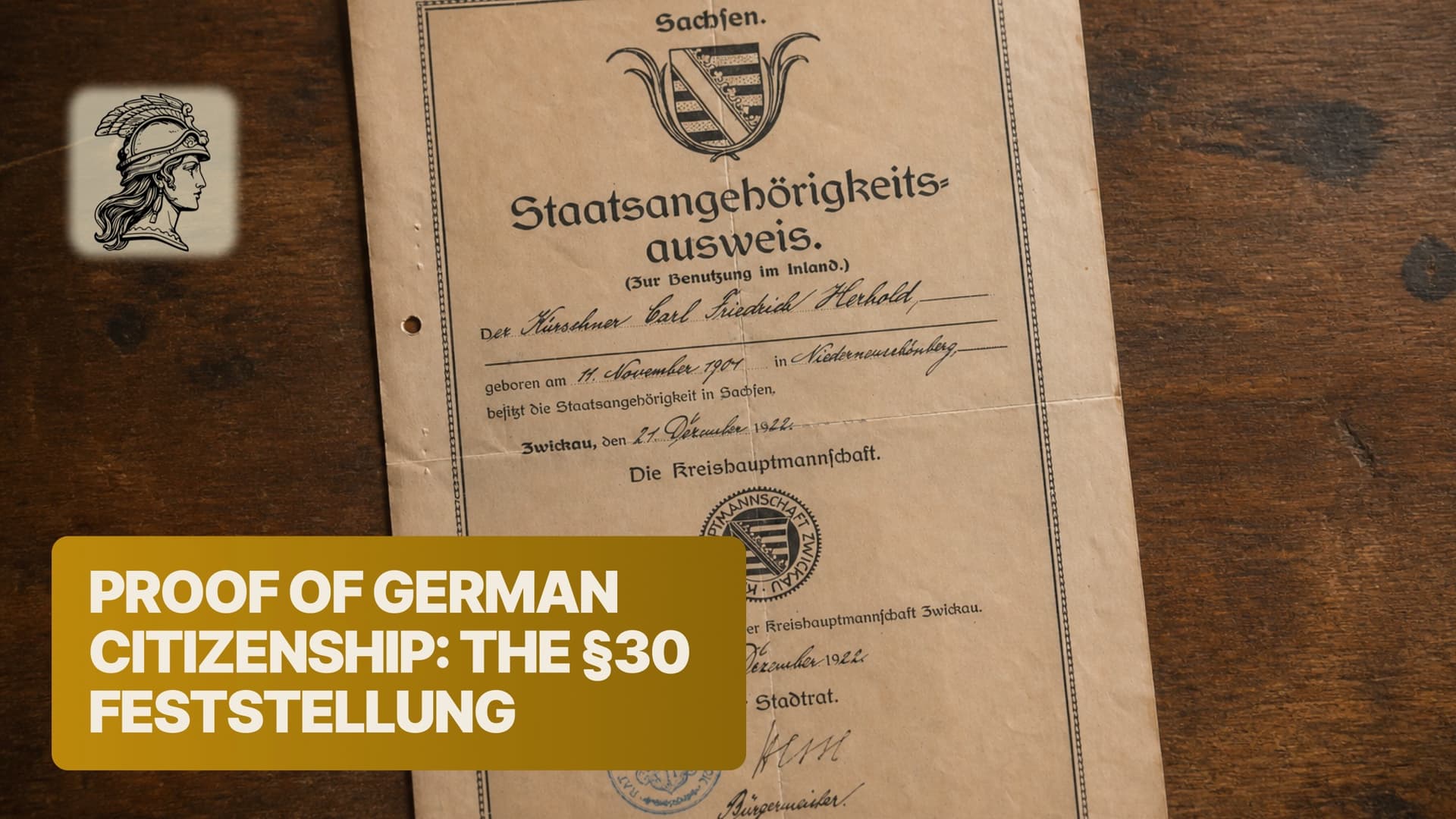
If you believe you inherited German citizenship through a jus sanguinis chain, a German passport is not proof. The Staatsangehörigkeitsausweis (certificate of nationality) issued by the Federal Office of Administration (Bundesverwaltungsamt) under §30 StAG is the only document that bindingly settles your status under German administrative law. Here is what the determination of citizenship (Feststellung) procedure involves and when it becomes essential.

What Most People Get Wrong About Proving German Citizenship
One observation comes up again and again in our intake calls. A client tells us they have carried a German passport for years, renewed it once or twice at the consulate, and they assume that settles the citizenship question for good.
It usually does not.
A passport confirms identity and the right to travel. It does not, on its own, constitute a binding administrative finding that you are German. That distinction can sound academic, right up until the day it stops being academic.
Proof of German citizenship by descent is a specific legal act, not a side effect of holding the right booklet. The two documents serve different functions, and confusing them is the single most common misunderstanding we encounter from descendants in the United States and Latin America.
What §30 StAG Says: The Feststellung as a Declaratory Act
§30 of the Staatsangehörigkeitsgesetz (StAG) provides the statutory basis for a formal Feststellung (determination) of existing German citizenship.
The operative word is existing. A Feststellung under §30 StAG does not confer citizenship. It confirms a status you either already hold or never held. In legal terms, it is a declaratory act, not a constitutive one.
The competent authority for this determination is the Bundesverwaltungsamt (BVA), the federal office in Cologne. An application under §30 StAG is unbefristet. There is no deadline. Unlike the declaration and restitution routes, this path does not close on a fixed date.
Why a German Passport Is Not Proof of Citizenship
Here is the heart of the matter. A passport is issued on the assumption that the holder is a citizen. A Staatsangehörigkeitsausweis is issued only after that assumption has been formally examined and confirmed.
That difference has real consequences. A passport application can be refused if German citizenship is not sufficiently established, and an issued passport can be declared invalid if it turns out that the holder is not German.
The law does contain a counterweight, but only after time has passed. Under §3(2) StAG, a person who has been treated as a German national by German authorities for twelve consecutive years, and who is not responsible for being so treated, acquires German citizenship by operation of law. That is an actual acquisition, not a presumption that can be rebutted. The acquisition takes effect retroactively, back to the point in time at which, while the person was being treated as a German national, the acquisition of citizenship was assumed to have occurred. It also extends to descendants who have derived their German citizenship from that person since that point. A passport is one of the forms of treatment the statute names; what produces the acquisition is twelve years of such treatment, not the passport itself. A determination under §30 StAG provides a binding finding on whether the person holds German citizenship, regardless of the ground of acquisition. The BVA's information sheet on the Feststellung procedure describes the certificate as the document that authoritatively establishes the existence of German citizenship, which a passport does not.
Consider a common scenario. A descendant with a U.S. passport applies for a German passport at the consulate. The consulate may issue it based on the records presented, without ever conducting a full §30 StAG Feststellung. In that case German citizenship was never authoritatively determined; the passport office took it as given for the purpose of issuing travel documents.
For everyday travel that may be enough. But if a later authority such as a court, an employer, or another government demands a binding answer to the question "are you German?", the passport alone may not deliver it. The Staatsangehörigkeitsausweis is the document that does.
The Life Events That Make the Feststellung Necessary
For many people the Feststellung sits in the background until a specific life event brings it forward. These triggers are where an abstract distinction becomes a practical need.
- A position in the EU civil service or a German public body that requires formal proof of citizenship, not just a passport.
- A dual-citizenship conflict, where another country asks you to renounce or document your German status before it will act, and you need a binding determination first.
- An inheritance or property matter in Germany, where your legal standing may turn on whether you are recognized as German.
- A discrepancy at the German consulate during a passport application, where the file raises a question that only a formal Feststellung can resolve.
- A family member's naturalization abroad that creates uncertainty about whether German citizenship was lost along the line.
- A wish to hold a binding status document before committing to an expensive, multi-generation genealogy project.
Each of these can require a §30 StAG determination, or arise alongside one. The common thread is simple. The moment someone other than a border officer needs a definitive answer, the certificate is what they are really asking for.
Who Issues the Certificate and What the Procedure Looks Like
The Bundesverwaltungsamt in Cologne is the central competent authority for applicants who live outside Germany. People residing inside Germany apply instead to their local Staatsangehörigkeitsbehörde (citizenship authority).
The application runs on the BVA's Form F together with the Anlage V (annex for ancestors) and, where applicable, Anlage K (annex for children), set out in the Merkblatt F. We will not reproduce the form here, and it is worth pulling the current version directly from the BVA rather than relying on an older copy.
The general flow is straightforward to describe, even if assembling it takes time. You submit the application together with a documented chain of descent. The BVA then reviews the file, and if the chain holds, it may issue the Staatsangehörigkeitsausweis. The outcome depends on the documents submitted. The BVA reviews each file and may issue the certificate, but issuance is never guaranteed at the point of application.
For U.S.-based applicants, the German Consulate General (for example in New York or San Francisco) can serve as a submission point, with the file ultimately decided by the BVA. Because the application is unbefristet, there is no clock forcing the timing, though the review itself is not fast. Realistically, the bottleneck is rarely the law. It is the document-gathering and the BVA's processing time, and timelines vary by authority and case.
Building the Jus Sanguinis Chain: What Documents You Need
The Feststellung stands or falls on the chain of descent. In practice this means a complete, generation-by-generation set of vital records running from the German ancestor down to you.
The core building blocks are the Geburtsurkunde (birth certificate) and Heiratsurkunde (marriage certificate) for each generation. On the German side, which office holds a given record depends on its age: within the statutory retention period (110 years for births, 80 for marriages, 30 for deaths) the local Standesamt (civil registry), and for older entries the relevant municipal or state archive, with the oldest entries found in the Kirchenbuch (church book) before civil registration began.
For U.S.-based applicants, one record often decides everything else: the German ancestor's naturalization file. The timing of that naturalization, relative to the birth of the next person in the line, can determine whether the chain stayed intact. If the ancestor naturalized in a federal court, the file is requested from NARA (the National Archives, roughly 10 USD, often 2 to 3 months), and that applies to any year up to October 1991. If the court was a county or state one, or is unknown, the file comes from USCIS, which can take around two years. This is the point most guides get backwards: 27 September 1906 is not the year NARA stops, it is the year from which naturalizations moved into the federal courts, so a later case is more likely to be at NARA. Getting it wrong changes both the cost and the timeline of the whole project.
Document requirements vary with case complexity, and the BVA will specify what it needs. If you suspect the chain may have a gap, the forensic analysis of where and why a chain breaks is a separate topic. We keep it out of scope here and cover it in our overview of §4 StAG citizenship by descent, so that this article stays focused on the determination itself.
What the Feststellung Does Not Fix: Knowing Its Limits
Because §30 StAG is purely declaratory, it only confirms an already intact §4 StAG jus sanguinis chain. It cannot repair a chain that was broken, and it cannot create a status that does not exist. That makes its limits as important as its function.
- It does not heal a maternal line that was blocked before 1 January 1975, or a non-marital paternal line for children born between 24 May 1949 and 31 December 1969 or between 1 September 1986 and 30 June 1993. Those cases may instead fall under the §5 StAG Erklärungserwerb (acquisition by declaration), with a deadline of August 19, 2031. See our §5 StAG declaration guide.
- It does not restore citizenship that was stripped during the NS era. Where citizenship was affirmatively withdrawn, the path may be Article 116 (2) GG restoration, which carries no generation limit and permits dual citizenship. See our Art 116(2) GG restoration guide.
- It does not substitute for §15 StAG Wiedergutmachung (compensatory naturalization) for persecuted persons and descendants who fall outside Article 116 (2). Unlike the §5 declaration above, §15 StAG carries no filing deadline.
- It does not override a prior voluntary renunciation.
In short, the Feststellung confirms what is there. It does not build what is missing.
Practical Takeaway: Is the Feststellung the Right Path for You?
The §30 StAG Feststellung may be the cleanest route to a legally binding status document if you have reason to believe your §4 StAG chain is intact.
That usually means the relevant parent was a German citizen at the time of your birth, that no ancestor's voluntary naturalization abroad broke the line before the next child was born, and that no older loss rule (such as the historic 1904 ten-year rule) cut the chain. In that situation the certificate simply converts a family-history belief into an official finding.
If instead your chain has a gap, or your ancestor was persecuted under the NS regime, a different provision applies, and the Feststellung alone may not be enough. That is where the routes above come in, and where misrouting wastes the most time.
This is also why the first step is almost always a case assessment rather than a form. Mapping which provision actually fits, and judging whether the document chain is likely to hold before you spend on archives and translations, is what keeps the project on the right track. Because §30 is unbefristet, there is no deadline pressure here. The urgency, when it exists, comes from the life events described earlier, not from a closing window.
CTA: If your family history suggests an intact German citizenship chain, a case review may clarify whether the §30 StAG Feststellung is the right next step, or whether another provision fits your facts better. Request your free eligibility check and let us help map which path your family history may support before you invest in document gathering.
Next step
Submit Your Lineage for a Free Assessment.