
In 2021, Germany quietly restored citizenship rights to descendants excluded by historical gender discrimination. That door does not stay open: the declaration must be filed by August 19, 2031, and most families who qualify have never heard of it.
Introduction
For most of the 20th century, German citizenship law treated men and women differently. Fathers could pass citizenship to their children. Mothers, in many cases, could not.
This was not a peripheral rule. It excluded entire branches of families from German citizenship across multiple generations. Mothers who were German by birth, by lineage, by every cultural measure, were legally unable to transmit that citizenship to children born before 1975.
In August 2021, the German Bundestag corrected this with §5 of the Staatsangehörigkeitsgesetz, known as §5 StAG. The full statutory text is published on the federal legal portal at gesetze-im-internet.de.
The reform was historic. It was also poorly communicated. Most descendants who now qualify have never heard of it. If you are not sure which pathway applies to your family at all, start with the German citizenship by descent guide.
The Deadline
The §5 StAG declaration procedure is currently available for ten years from the effective date, until August 19, 2031.
After that, the legal pathway, as written, expires. Whether it will be extended is a political question, not a legal certainty.
For families with eligible cases, the practical window is shorter than it appears. Document retrieval from German, Polish, and Czech archives often takes six months or longer. Translation, apostille, and consular processing add further time, and what the whole file actually costs is worth knowing before you start. A case begun in 2030 is unlikely to be filed in time.
The Historical Background
Until January 1, 1975, German citizenship law followed the principle of patrilineal descent for children born in wedlock. Citizenship passed from father to child, automatically and exclusively. The historical framework is documented in the overview of German nationality law on Wikipedia.
For children born out of wedlock, the rule was reversed. They inherited from the mother.
The combination produced a paradox. A German woman married to a foreign man could not pass her citizenship to her legitimate children. The maternal line under §5 StAG is the case this article exists for. The same woman, unmarried, would have transmitted it without question.
This rule remained in force, with limited modifications, until the 1975 reform that introduced full gender equality in citizenship transmission going forward. But the reform was not retroactive. Children born before 1975 to German mothers and foreign fathers remained excluded.
For nearly five decades, those children, and their own children, had no legal pathway to German citizenship through the maternal line.
What §5 StAG Changes
§5 StAG, effective August 20, 2021, creates a declaration-based naturalization procedure (Erklärungserwerb) for descendants who were excluded from German citizenship solely because of historical gender discrimination or out-of-wedlock birth rules. The reform was enacted as the Fourth Act Amending the Nationality Act, as confirmed by the Federal Ministry of the Interior.
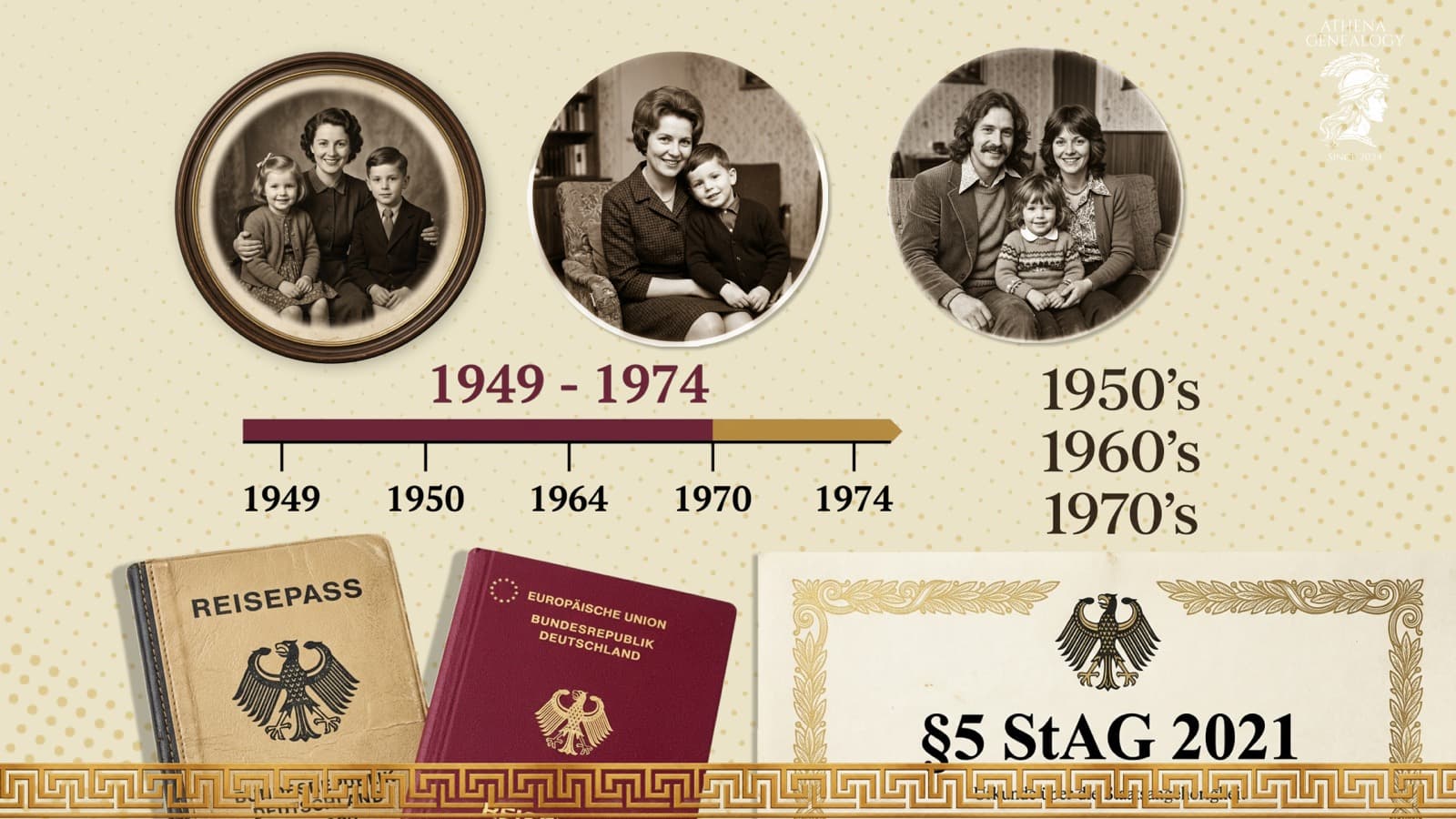
The provision covers several groups. Children of German mothers and foreign fathers, born between May 23, 1949 and December 31, 1974, in wedlock. Children of German fathers and foreign mothers, born out of wedlock between May 23, 1949 and June 30, 1993, where paternity was acknowledged but citizenship did not transfer. Descendants of these excluded individuals, including grandchildren and great-grandchildren.
Technically, §5 StAG is a form of naturalization. The mechanism is a declaration (Erklärung), but the legal effect is that German citizenship is acquired upon issuance of a case number for your application, not retroactively from birth. In practice, this means applicants become German through the declaration procedure, which is procedurally simpler than a standard naturalization but legally still classified as one. The provision corrects a historical injustice by offering a streamlined pathway, not by recognizing a citizenship that always existed.
Who Qualifies Today
The clearest qualifying profile is straightforward. A grandmother born in Germany, who married a non-German man and emigrated. Her children, born abroad before 1975, were denied citizenship at birth. Today, those children and their descendants can declare under §5 StAG. The official explanation for descendants of a German mother or father who never were considered German is published by the German Federal Foreign Office.
The pathway is generational. A grandmother's eligibility flows down to grandchildren and great-grandchildren, provided the chain is documented at every step.
There is no language requirement. No residency requirement. No renunciation of existing citizenship.
What §5 StAG Is Not
It is worth being precise about what this provision does not do.
It does not cover voluntary renunciations. Ancestors who actively gave up German citizenship are not within its scope. It does not cover losses caused by independent naturalization in another country. It does not extend to descendants whose families left Germany before 1904 without consular registration, since citizenship was lost for a different reason entirely.
§5 StAG is a targeted declaration-based naturalization remedy for one specific historical wrong: gender discrimination and illegitimacy rules in German citizenship law. It is not a general amnesty, and it is not a retroactive recognition of citizenship that already existed. It is a legally simplified route to acquiring German citizenship for those previously excluded.
Why Many Eligible Applicants Are Missed
Three factors explain why §5 StAG remains underused.
First, the reform was passed without significant international communication. German consulates abroad mention it on their websites, including the Federal Foreign Office's overview of nationality law, but few descendants of German emigrants check those sites unprompted.
Second, the applicable cases are technically narrow but factually common. Many families fit the profile without realizing it, because the gender issue is not part of their family story. They simply know "we have a German grandmother" and assume it is too late.
Third, the legal community outside Germany has been slow to absorb the change. Many immigration lawyers and even some consular advisors still operate on pre-2021 frameworks.
The Practical Takeaway
If you have a German maternal ancestor born before 1975, your case did not close in the 20th century. It reopened in 2021. The documents you will need are the same set every declaration rests on.
The question is whether you can document the chain and file within the available window. That requires identifying the correct legal subsection of §5 StAG, retrieving the right civil records, and coordinating the declaration with the appropriate German mission. The procedural steps are described in detail by the Federal Office of Administration (BVA), which is the competent authority for declarations filed from abroad.
This is not a do-it-yourself procedure. The applications are technical, the supporting documentation is specific, and consular reviewers expect the file to arrive in the correct format.
Closing
§5 StAG is one of the most significant changes to German citizenship law in a generation. It corrects a discrimination that lasted decades and opens a simplified naturalization pathway to descendants who were quietly excluded from their own heritage.
The pathway is open. It will not stay open forever.
Next step
Submit Your Lineage for a Free Assessment.