
If your German ancestor was a woman, or your German father was not married to your mother, the 2021 StAG reform may have opened a citizenship path your family did not know existed. The statutory window closes on August 19, 2031.
Why So Many Maternal-Line Claims Have a Broken Chain
Many of the families who reach us open with the same sentence: "My grandmother was German, so I should be able to claim the passport."
Then the records arrive, and the chain does not hold.
German citizenship by descent runs on jus sanguinis, the principle that citizenship passes from parent to child by blood rather than by place of birth. That rule is set out today in §4 StAG, and it sounds simple. In practice it has a long history of breaking in two very different ways.
The first break is the one most people expect. A German ancestor emigrated, took a foreign citizenship abroad, and lost German citizenship in the process. If the next child in the line was born after that naturalization, the child never inherited German citizenship at all. The chain is broken at that point. (Our §4 StAG overview walks through this break in detail.)
The second break is quieter, and it is the reason maternal-line cases are so often dismissed too early. For most of the last century, a German mother could not pass her citizenship to a child born in marriage on the same terms as a German father. The chain did not break because anyone emigrated. It broke because the law treated the mother's line as a dead end.
That is the gap §5 StAG was written to close.
How German Citizenship Law Created a Gender and Marital-Status Gap
To see why so many descendants fall through, it helps to read the old rules against the calendar.
Under the RuStAG of 1913, German citizenship was framed around the father. A child born in wedlock followed the father's citizenship. A German woman who married a foreigner could lose her own citizenship, and her children would typically take the father's nationality instead of hers.
The rules on loss of citizenship through marriage themselves shifted over time, and the exact date of the marriage matters. A German woman who married a foreign man before 23 May 1949 always lost her German citizenship through the marriage itself. Between 23 May 1949 and 1 April 1953, a German woman lost her citizenship through marriage to a foreigner only if she would not have become stateless as a result. Three short examples make the distinction concrete:
Example 1: Husband American, wife German; no automatic acquisition of US citizenship through the marriage; the wife remains German, because she would otherwise be stateless.
Example 2: Husband American, wife holds German and another citizenship (e.g. US); loss of German citizenship, because she does not become stateless.
Example 3: Husband Polish, wife German; automatic acquisition of Polish citizenship through marriage before 19 January 1951; loss of German citizenship, because the wife becomes Polish through the marriage itself.
Four cut-off dates do most of the damage in real cases.
A child born in marriage to a German mother and a foreign father before 1 January 1975 generally did not acquire German citizenship through her.
A child born outside marriage to a German father and a foreign mother after 23 May 1949 and before 1 July 1993 often did not acquire it through him under the rules of the time.
A German mother who lost her citizenship by marrying a foreigner before 1 April 1953 could not transmit what she no longer held (subject to the marriage-date rules just described).
Citizenship lost through legitimation before 1 April 1953 could cut a line in the same way.
None of these are about emigration. They are about gender and marital status. For decades, descendants in exactly these situations were told they had no claim. After 2021, many of them do.
What §5 StAG (Erklärungserwerb) Actually Provides
§5 StAG was introduced by the StARefG 2021, the fourth amendment to the German Citizenship Act. It created a procedure called Erklärungserwerb, acquisition of citizenship by declaration.
This is not a discretionary naturalization where an official weighs your case. It is a declaration. If you fall into one of the defined groups and you meet the formal requirements, you declare your acquisition of German citizenship, and the authority records it.
Two features make §5 far more powerful than it first appears.
First, it reaches down the line. Under the descendants provision (the Abkömmlinge rule), where a parent qualifies by declaration, their children can typically qualify as well, with no generation limit. One historical act of discrimination at the top of the tree can be repaired for everyone below it.
Second, it does not force you to give up another passport. Combined with the StARModG 2024, the 2024 reform that broadly accepted multiple nationality, a successful §5 declaration generally lets you hold German citizenship alongside your existing one.
The procedure is administered by the Bundesverwaltungsamt (BVA), the Federal Office of Administration. A declaration may also be filed through a German Consulate General in the United States, which forwards it to the BVA. The deadline is fixed, and we return to it below.
The Three Groups §5 StAG Was Designed to Help
Most competitor pages mention §5 in a single line. The cases divide cleanly into three groups, and you can usually place yourself in under two minutes.
Group one: the maternal line before 1975. Your German-born ancestor was a woman. A child in your line was born in marriage to that German mother and a non-German father before 1 January 1975, and the law of the time blocked transmission through her. This is the classic maternal-line case, and it is the largest single group we see under §5.
Group two: the unwed father line. Your ancestor was a German father who was not married to the child's mother, and the child was born after 23 May 1949 and before 1 July 1993. Under the old rules, that child acquired German citizenship through the father only where paternity had been acknowledged or judicially established (Vaterschaftsanerkenntnis or -feststellung); without that step, the line frequently did not pass. This is precisely the situation that, before 2021, was written off as no claim. It may now qualify under the declaration procedure.
Group three: post-war loss by marriage or legitimation. Your German female ancestor lost her citizenship by marrying a foreigner before 1 April 1953, or a line was severed by legitimation before 1 April 1953. §5 was drafted to reach these administrative losses as well.
If you recognize your family in one of these three pictures, the next step is documents, not despair.
What §5 StAG Does Not Fix: Common Misunderstandings
§5 is wide, but it is not a universal repair, and filing under the wrong provision wastes months.
A pure naturalization break is generally not healed by §5. That is the case where the only thing that happened is that your ancestor took a foreign citizenship before the next child was born, with no gender or marital-status discrimination involved. In that situation the line may simply be broken for descent purposes, and any path would run through ordinary naturalization instead.
One important caveat sits inside this rule, and it is easy to miss. Between 1 April 1914 and 31 March 1953, a foreign woman automatically acquired German citizenship by marrying a German man. There are therefore cases where descendants can still use §5 StAG even though the German male ancestor naturalized abroad before the next ancestor in the line was born, because his wife had already become German through the marriage and was still German at the time of the child's birth.
Example: Husband German, wife American, married on 12 January 1943; the husband naturalizes (abroad) in 1945; a son is born on 30 September 1949. The son and his descendants are entitled to declare under §5 (1) no. 1 StAG, because the mother was German at the time of the son's birth and the transmission problem is the pre-1975 maternal-line rule.
The more important off-ramp is persecution. If your ancestor lost German citizenship because they were persecuted under the Nazi regime between 30 January 1933 and 8 May 1945, your route is almost certainly not §5.
For those families, the correct provisions are Article 116 (2) GG, the constitutional restoration of citizenship stripped on Nazi grounds, and §15 StAG, the restitution naturalization (Wiedergutmachungseinbürgerung) for victims of persecution and their descendants who fall outside Article 116 (2). The BVA publishes a dedicated comparison of the two. Article 116 (2) has no generation limit, permits dual citizenship, and, unlike descent claims, does not turn on the emigration date at all. Our Article 116 (2) GG guide explains when it applies.
The practical risk is a mixed family. Gender discrimination and Nazi-era deprivation can both appear in one tree, depending on each person's birth date relative to the events. Filing everything under §5 because it was the first provision someone read about is a common and costly error.
Building Your Case: Documents and Evidence
Every descent case turns on one forensic question. Did the German ancestor take a foreign citizenship, and when, relative to the birth of the next person in the chain?
That is why naturalization research is almost always the first document we pull. The answer decides whether you have an intact chain, a gender-discrimination case for §5, or a persecution case for Article 116 (2) or §15.
For an ancestor naturalized in the United States, what matters is the court rather than the year. A federal court naturalization is held by the National Archives (NARA), which can return the record for roughly 10 US dollars in about two to three months, and NARA covers federal court cases up to October 1991. USCIS holds a duplicate from 27 September 1906 onward, and that request typically takes around two years, so it is the slower route rather than the required one. Latin American records (Argentina, Brazil, Chile) follow their own civil-registry routes.
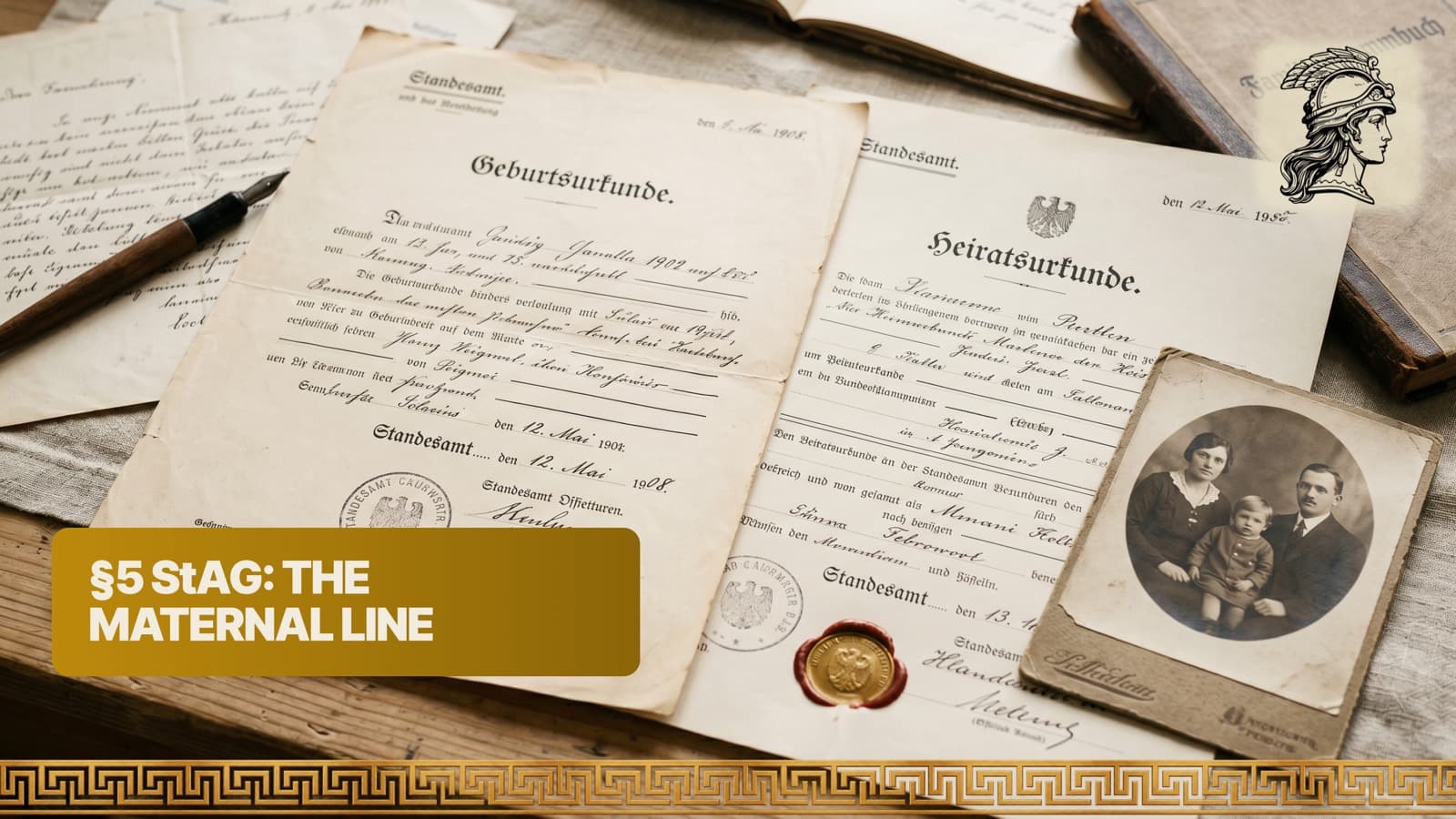
On the German side, the anchor documents are the vital records: the Geburtsurkunde (birth certificate), the Heiratsurkunde (marriage certificate), and the underlying Standesamt (civil registry) entries, with Kirchenbuch (church book) records standing in for births before civil registration began in the 1870s.
Where your ancestor came from the former German eastern territories, now in Poland, the Czech Republic, or Russia, the central fallback office is the Standesamt I in Berlin. If a register was destroyed in the war, that office issues a Negativbescheinigung, a negative certificate. This is a usable substitute, not the end of the case. Descent can then be shown through church books, archive files, or sworn statements.
A useful detail: for genuinely German documents requested from a German authority, you generally need no apostille and no translation. The apostille and the sworn German translation are for your foreign records.
The Auswärtiges Amt and the German consulates publish acquisition and loss guidance that mirrors these rules.
The realistic sequence is: research the ancestor's naturalization, gather the missing vital records as full long-form copies for each generation, apostille the foreign documents, obtain sworn German translations, complete the paperwork with a cover letter, and send the file to the BVA in Cologne.
The Hard Deadline: August 19, 2031
Not every German citizenship route has a clock. This one does.
The §5 declaration window closes on August 19, 2031. After that date, the declaration door for these discrimination cases is expected to shut, and the statute itself names the cut-off in §5 StAG.
Two other paths are open-ended for contrast. The §30 StAG determination and Article 116 (2) GG restoration carry no deadline. The §5 route does, and that changes the planning.
Here is why 2031 is closer than it looks. The bottleneck in these cases is rarely the law. It is the running time. A US naturalization file from USCIS can take around two years to arrive, and after your declaration reaches the BVA there is a long passive waiting phase, often in the range of two years, during which the office processes the file internally and typically contacts you on its own initiative rather than responding to status inquiries. A file reference usually appears only after several months.
Stack a multi-year document search in front of a multi-year processing wait, and a 2031 deadline is something to begin now, not later. Timelines vary by authority and by case, and nothing here is a promise of a particular outcome or speed.
Is §5 StAG the Right Path? A Practical Summary
A short triage, in plain terms.
If your chain looks intact, meaning each child in the line was born before the relevant ancestor lost German citizenship, you may not need a declaration at all. You may already be German and simply need a formal §30 StAG Feststellung (determination) using the BVA determination guidance.
If your break traces to gender or marital status, a German mother before 1975, an unwed German father before 1993, or a pre-1953 loss by marriage or legitimation, §5 may be your route, and it may carry the whole line below you.
If your break traces to Nazi-era persecution between 30 January 1933 and 8 May 1945, your route is more likely Article 116 (2) GG or §15 StAG, and you should not misfile under §5. For persecution cases, a sensible free first step is the Arolsen Archives online search.
Most real families do not fit one box cleanly. The break is the normal case, not the exception, and which repair applies depends on specific birth dates and naturalization dates that only the documents can confirm.
This page is for general information and is not legal advice. Eligibility depends on the specific facts of your family history.
Next step
Submit Your Lineage for a Free Assessment.