
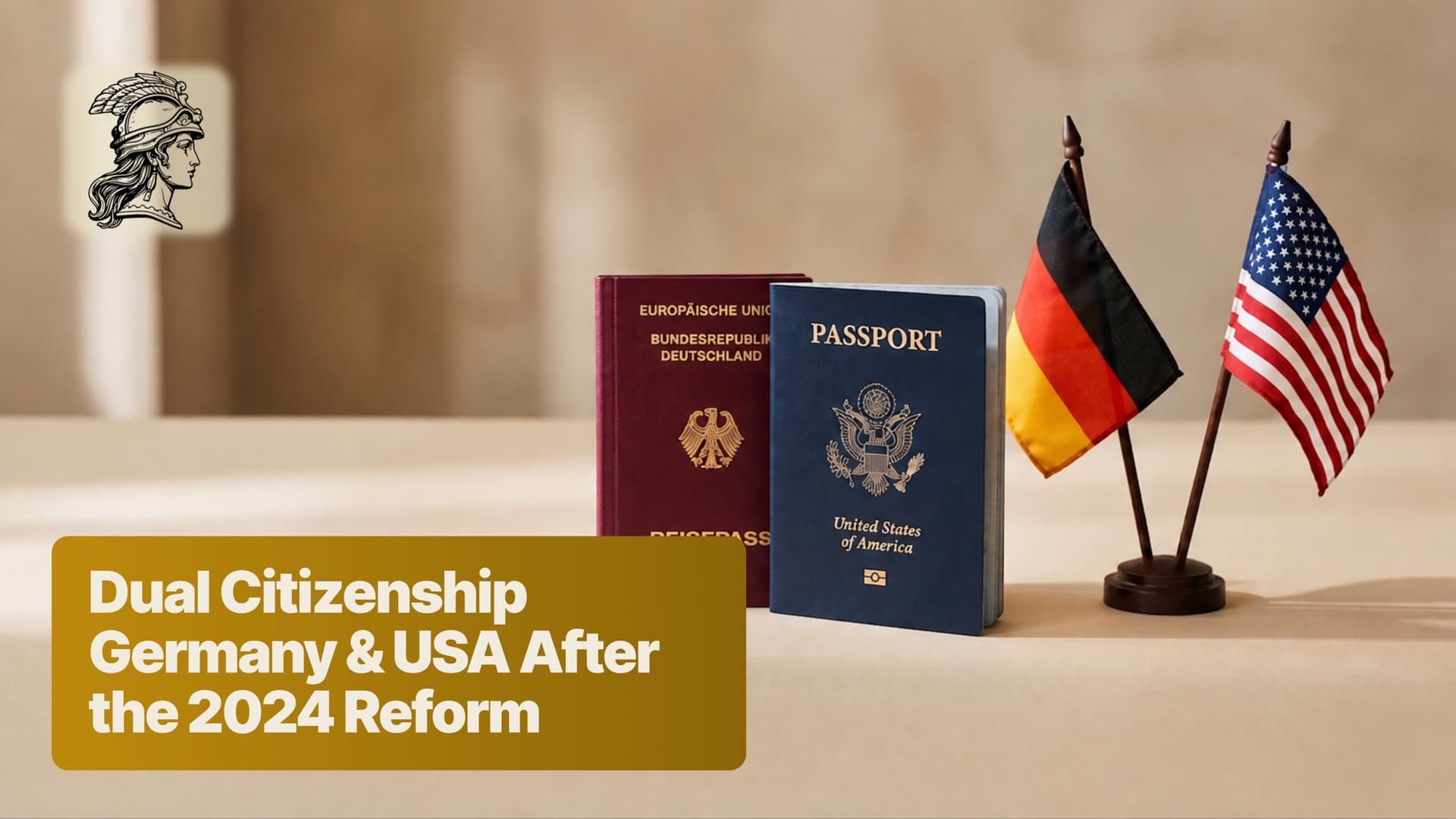
Germany's 2024 StARModG reform allows dual citizenship with the USA. Find out what changed for descent applicants and whether you can keep both passports.

The Question Every German-American Asks
"I almost didn't call. I assumed claiming a German passport would mean handing back my American one."
We hear a version of that sentence often.
For years, many descendants of German emigrants held back from even checking their eligibility. They were convinced that a German passport would cost them their US citizenship.
That fear was grounded in real law. It is also out of date.
The reform that took effect on 27 June 2024 changed the landscape for anyone holding, or hoping to hold, two passports.
This article is written for one specific audience: people whose German ancestry may already entitle them to citizenship by descent. That means the descent and restitution routes under §4 StAG, §5 StAG, §15 StAG, and Art 116(2) GG.
It is not written about §10 StAG, the residence-based naturalization route that most general reform coverage focuses on. If you are claiming through a German parent, grandparent, or great-grandparent, the descent angle is the one that matters to you.
What §25 StAG Said, and Why US Applicants Were Cautious
Until mid-2024, German law contained a forced-renunciation clause.
A German national who voluntarily acquired a foreign citizenship generally lost their German citizenship automatically, at the moment of the foreign naturalization, unless they had secured a retention permit (Beibehaltungsgenehmigung) in advance.
That rule traces back to §25 of the old Reichs- und Staatsangehörigkeitsgesetz (RuStAG) of 1913, which applied from 1 January 1914 and was later carried into the modern Staatsangehörigkeitsgesetz (StAG) as §25 StAG. You can read the historical §25 wording in the RuStAG 1913 text.
For a US resident, the message felt simple and discouraging: take the American oath, lose the German status.
That deterrent shaped a generation of decisions. Many eligible descendants never applied, assuming the price was too high.
Two clarifications matter here. First, this loss rule applied to a German who actively naturalized abroad. Second, that is a different question from whether a descendant ever inherited German citizenship in the first place.
What the StARModG 2024 Actually Changed, Effective 27 June 2024
The Gesetz zur Modernisierung des Staatsangehörigkeitsrechts (StARModG) took effect on 27 June 2024.
Its headline change for this audience: the forced-loss clause was repealed. Germany now formally accepts multiple nationalities, including the combination of German and US citizenship.
The reform sits within the framework set by the Federal Ministry of the Interior. The Bundesinnenministerium and the German missions abroad through germany.info publish the official overviews of how citizenship is acquired and lost.
This is the part many readers get right.
Here is the part many get wrong: the repeal is not retroactive.
A person who already lost German citizenship before 27 June 2024 by voluntarily naturalizing in another country does not automatically regain it because the clause was later removed.
The old loss happened under the law in force at the time. Removing the clause going forward does not reach back and undo a loss that was already complete.
If that describes your family, the door is not necessarily closed. It simply means a separate eligibility assessment is needed, rather than an assumption that 2024 fixed it for you.
The Four Descent Pathways: Which Ones Does 2024 Affect?
For descent applicants, the 2024 reform mostly answers a single question: if you succeed, may you keep your US passport? The short answer is now yes. Here is how that plays out on each route.
§4 StAG: standard descent. This is jus sanguinis, citizenship inherited by blood from parent to child along an unbroken chain. The provision is set out in §4 StAG. A descendant who can prove the chain held may have their existing German citizenship confirmed, and since 2024 can hold the US passport alongside it. Whether the chain held usually turns on one forensic question: did the German ancestor naturalize abroad before or after the next child in the line was born? A child born before that naturalization may have inherited German citizenship; a child born after it may never have acquired it, which can redirect the case toward §5 or a restitution route. Our §4 StAG citizenship by descent explainer covers how the chain works.
§5 StAG: acquisition by declaration. The declaration procedure under §5 StAG (Erklärungserwerb) was introduced by the 2021 reform to heal historical gender-based discrimination. That includes German mothers who could not pass on citizenship before 1975, and fathers in certain non-marital cases before 1993. Successful applicants share the dual-passport position. One date controls here: declarations must be filed by 19 August 2031. The current forms sit in the BVA EER package. Our §5 StAG declaration explainer covers who may qualify and the filing window.
§15 StAG: Wiedergutmachungseinbürgerung. The naturalization for victims of National Socialist persecution under §15 StAG and their descendants carries the same dual-passport benefit. Unlike §5 StAG, it carries no filing deadline.
Art 116(2) GG. This pathway had its own logic long before 2024, and deserves its own section below.
Art 116(2) GG: The Pathway That Never Needed the 2024 Reform
Article 116(2) of the Grundgesetz (https://www.gesetze-im-internet.de/gg/art_116.html) restores German citizenship to people whose citizenship was withdrawn on political, racial, or religious grounds between 30 January 1933 and 8 May 1945, and to their descendants.
This pathway was already compatible with dual citizenship before the 2024 reform.
The reason is conceptual. Art 116(2) is a restitution of a status that was wrongly stripped away. It is not a voluntary acquisition of a foreign citizenship in the sense the old §25 clause targeted.
Because the forced-loss logic never applied, the route carried features that descent applicants often find striking: no generation limit, no application deadline, and a dual passport (Doppelpass) consistently permitted. The BVA explains the boundary between this constitutional route and §15 StAG in its Wiedergutmachung infobox.
The 1904-rule does not apply here either. That rule, the ten-year loss for emigrants under §21 RuStAG 1870, hangs on emigration. Art 116(2) hangs on the Nazi-era deprivation, a different anchor entirely.
For this audience, 2024 is additive context, not the foundation. If your family lost German citizenship through Nazi persecution, your claim never depended on the reform.
Our Art 116(2) GG restitution explainer covers the no-generation-limit feature in detail.
What the 2024 Reform Does NOT Do: Three Common Misreadings
Misreading one: it does not retroactively restore citizenship. The repeal of the §25 forced-loss clause does not give back German citizenship to someone who lost it before 27 June 2024 by naturalizing abroad. The loss already took effect under the earlier law.
Misreading two: it does not create a new pathway. The descent and Wiedergutmachung routes (§4, §5, §15, and Art 116(2) GG) all existed before the reform. The 2024 change governs whether you may hold two passports, not whether you qualify in the first place.
Misreading three: it does not touch the US side. Whether acquiring a German passport affects your American citizenship is a question of US law, not German law. The next section addresses that directly.
The US Side: Does Acquiring a German Passport Affect US Citizenship?
German law no longer asks you to give up your US passport. The remaining question is what US law does.
As a matter of general background, US nationality law treats the loss of US citizenship as something that requires a voluntary act performed with the specific intent to relinquish it. Under the relevant provisions of the Immigration and Nationality Act, simply holding a second passport does not, by itself, demonstrate that intent.
Dual nationality is common among US citizens. Acquiring German citizenship by descent does not, on its own, force a renunciation of American citizenship.
This is general information, not US legal advice. US citizenship questions sit outside German law and outside our scope, so confirm your individual situation with a qualified US immigration attorney before relying on any of it.
Practical Takeaway for US Applicants Pursuing a German Passport
Since 27 June 2024, both countries allow their citizens to carry the other's passport. A descent applicant who succeeds can realistically expect to hold both a German and a US passport at the end of the process. What that dual status is actually worth in practice, from EU freedom of movement to healthcare, education and the tax position, is set out in our guide to what dual citizenship gets you.
If you believe you personally lost German citizenship before 27 June 2024 by naturalizing as a US citizen, do not assume the reform reversed it. The repeal is not retroactive, and your situation needs its own assessment. Worth knowing here: §3(2) StAG can create a rebuttable statutory presumption of German citizenship once a person has been treated as a German national by the authorities for twelve years, which is one of several factors a proper review weighs before concluding that a status was lost.
For §5 applicants, the date that actually controls your window is 19 August 2031, not the 2024 reform. By contrast, §15 StAG restitution, the §30 StAG determination and Art 116(2) GG restitution carry no deadline at all.
The reform settled the dual-passport question. Which pathway fits your family, and whether the chain of descent held, is still the decisive piece, and that depends on the specific facts of your ancestry.
CTA: If your family has German roots, whether through standard descent under §4 StAG, a declaration under §5 StAG, persecution-based restitution under §15 StAG, or Art 116(2) GG, you may now be able to hold both a German and a US passport. The route that fits depends on dates, documents, and where the chain of descent did or did not break. Start with a free eligibility check to find out which pathway could match your family history. There is no obligation, and it could be the difference between assuming you do not qualify and discovering that you might.
Next step
Submit Your Lineage for a Free Assessment.