
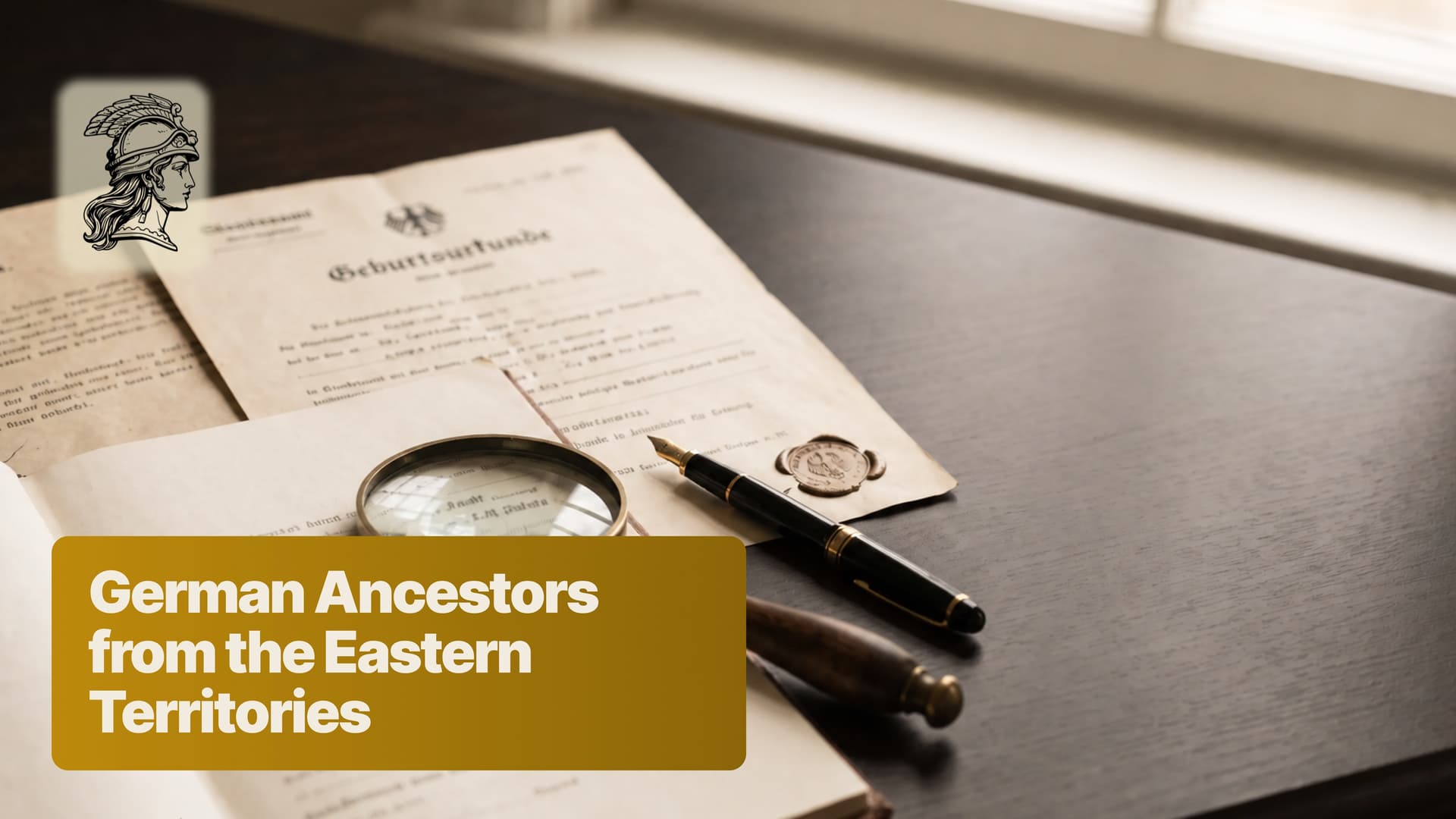
Ancestry from Silesia, East Prussia, or the Sudetenland may support a German citizenship claim. Understand which legal pathways apply to your family history.
Introduction: Why Eastern Territories Matter for German Citizenship
"My great-grandmother always said the family was from Breslau. But Breslau is in Poland now, so I assumed that was the end of it."
That sentence, or a version of it, opens a large share of the first conversations we have with clients in the United States and in Latin America.
It rests on a misunderstanding. German citizenship by descent does not follow today's borders. It follows a legal chain: did an ancestor hold German citizenship at the moment the next person in the line was born, and did each generation pass it on?
A town that is now Wrocław, Kaliningrad, or Ostrava tells you where the records are. It does not tell you whether a claim exists.
German citizenship from former eastern territories is therefore not a special legal category. It is ordinary descent law applied to families whose paper trail was scattered by displacement, war losses, and redrawn borders. The law is often the easier half of the problem. The documents are the hard half.
The Historical Landscape: German Populations in the Lost Territories
Before 1945, large German-speaking populations lived in regions that are today part of Poland, Russia, and the Czech Republic. Silesia, East Prussia, Pomerania, and the Free City of Danzig were part of the German state structure. The Sudetenland was not, and that distinction matters legally.
Emigration from these regions to the Americas happened in several waves. Some families left in the nineteenth century for economic reasons. Others fled between 1933 and 1945 under Nazi persecution. Others again were expelled after the war.
Each of these waves produces a different legal question.
A family that left Silesia in the 1880s runs into the loss rules of the old Reichs- und Staatsangehörigkeitsgesetz. A family that fled East Prussia in 1938 because of persecution may fall under the restitution provisions instead. A family expelled in 1946 usually kept its citizenship, and the question becomes purely evidentiary.
The starting point is never the region. It is the date and the reason of departure, set against the birth dates of the descendants.
The 1904 Rule: A Critical Cutoff for Pre-1904 Emigration
The so-called 1904 rule is the single most common reason a nineteenth-century emigration line ends without a claim.
Under Paragraph 21 of the Reichs- und Staatsangehörigkeitsgesetz of 1870, a German who lived abroad for ten years without registering with a German consulate lost German citizenship automatically. The practical consequence: many families who emigrated well before the turn of the century had already lost their German status before the modern law took effect on 1 January 1914. That is why the year 1904 appears again and again in our case files.
Registration in the Konsulatsmatrikel, the consular register, could interrupt the ten-year period. Very few emigrant families did this, and fewer still kept proof of it.
After 1914, the relevant loss provision changed. Under Paragraph 25 of the Reichs- und Staatsangehörigkeitsgesetz of 1913, a German lost citizenship upon voluntary naturalization in a foreign state. This is the mechanism that blocks most twentieth-century chains.
Two points are worth holding onto. First, the 1904 rule and the naturalization rule both hinge on a date comparison, not on a feeling about how German the family was. Second, the 1904 rule does not apply to restitution claims under Article 116(2) of the Basic Law, because that pathway is tied to the Nazi-era deprivation of citizenship, not to the date of emigration. A more detailed treatment sits in our guide to the 1904 rule.
Standard Descent Under §4 StAG: Proving an Unbroken Chain
German citizenship passes by descent, jus sanguinis, under Paragraph 4 StAG. A child acquires it at birth from a German parent. No ancestral home, no ethnic identity, no language competence enters into it.
The forensic anchor of every descent case is one question: did the German ancestor take a foreign citizenship, and when, measured against the birth of the next person in the chain?
If the child was born before the parent naturalized abroad, the child acquired German citizenship at birth and the chain holds. The case is then usually a Feststellung, a determination of citizenship under Paragraph 30 StAG, documented with the BVA information sheet for determination proceedings.
If the child was born after the parent naturalized, the parent had already lost German citizenship. The child never acquired it, and the chain is blocked.
This is why the naturalization research on the emigrant ancestor is almost always the first document we order, before any birth certificate. It decides which pathway the family is on.
In our own case files, a blocked chain is the normal situation rather than the exception. Roughly forty percent of files at application stage run through the declaration procedure because the chain was broken. Roughly a quarter are intact chains handled as a Feststellung. The remainder splits between mixed families where siblings fall on different sides of a naturalization date, restitution cases under Article 116(2) and Paragraph 15 StAG, and files still in early document collection where the pathway is not yet determined. More detail on the standard route is in our overview of descent under Paragraph 4.
Restitution Pathways: Article 116(2) and §15 StAG for Nazi Victims
Many families from Germany did not emigrate. They fled.
For persons persecuted between 30 January 1933 and 8 May 1945 on political, racial, or religious grounds, and for their descendants, Article 116(2) of the Grundgesetz provides for restoration of the citizenship that was taken away. This pathway has no generational limit, no deadline, and it permits dual citizenship.
There were two deprivation mechanisms. The Eleventh Decree to the Reich Citizenship Law of 25 November 1941 stripped citizenship collectively from Jewish Germans whose habitual residence was abroad. The Denaturalization Law of 14 July 1933 stripped it individually by name, with the lists published in the Reichsanzeiger, and here no foreign residence was required.
Alongside the constitutional route sits Paragraph 15 StAG, a statutory naturalization pathway for Wiedergutmachung with a claim character where the requirements are met. Its reach is not limited to descendants. In several constellations it also covers persons who would have become German themselves had the persecution not occurred, under Paragraph 15 No. 4 StAG. Neither Article 116(2) nor Paragraph 15 StAG carries a deadline.
Whether a departure counts as voluntary emigration or as persecution-driven flight is a question of the individual facts. A family that left in 1936 and naturalized in Argentina in 1942 may well sit in both categories. In such files both Paragraph 15 StAG and Article 116(2) should be examined in parallel rather than one being assumed. Our dedicated guide covers Article 116(2) in depth.
The Sudetenland Puzzle: Why Ethnicity Isn't Enough
Sudeten German ancestry produces more disappointed inquiries than any other regional profile, and the reason is structural.
The Sudetenland was not part of the German state before 1938. It belonged to Austria-Hungary until 1918 and then to Czechoslovakia. A family could be German-speaking, Lutheran or Catholic in a German parish, culturally German for centuries, and still never have held German citizenship in the legal sense.
German law under Paragraph 4 StAG attaches citizenship to descent from a German national. It does not attach it to ethnicity, language, or expulsion from a German-speaking region.
So the Sudeten case is never resolved by family identity. It is resolved by documents that show whether a specific ancestor held German citizenship at a specific date, and if so, on what legal basis. Sometimes that evidence exists. Often it does not, and the honest answer is that the family history is German while the legal claim is not.
Where persecution is part of the family story, the restitution routes should still be examined, because they run on a different logic from ordinary descent.
Documentation Challenges: Reconstructing Records from Lost Homelands
Which German office holds a record depends on the age of the entry. Within the statutory retention period the local Standesamt keeps it. German civil registry law sets those periods at 110 years for birth records, 80 years for marriage records, and 30 years for death records. After that the record moves to a state or city archive. For entries before the introduction of civil registration in the 1870s, the source is the Kirchenbuch, the church book.
For the former eastern territories there is a central substitute office: the Standesamt I in Berlin. It holds the surviving duplicate registers for Danzig, Silesia, East Prussia, Pomerania, and comparable regions.
Where a register was destroyed in the war, that office issues a Negativbescheinigung, a certificate of non-existence. This is a usable substitute document and not the end of a case. Descent can then be evidenced through church books, Bundesarchiv files of the Einwandererzentralstelle in holdings R 69 and R 9361, an expellee identity card, or sworn declarations.
For persecution files, start with the free online archive of the Arolsen Archives before paying any institution for a search. Persecution is also often visible in the German records themselves, through a religious annotation such as "mosaischer Religion" or through the forced middle names Israel and Sara that were imposed from 1939 under the Second Decree on the Alteration of Family Names of 17 August 1938.
German documents submitted to a German authority generally need neither an apostille nor a translation. Our regional guide covers records from Poland in more detail.
How a Case Is Built: From Family Lore to Legal Evidence
The sequence is deliberate, and it rarely starts where clients expect.
First comes the naturalization research on the emigrant ancestor, because that single date decides the pathway. In United States cases the watershed is 27 September 1906. Naturalizations before that date sit with NARA, cost about ten dollars, and typically take two to three months. Naturalizations from 1906 onward sit with USCIS and commonly take around two years.
Second come the missing vital records for each generation, always in long form: Geburtsurkunde, Heiratsurkunde, and where relevant the death record.
Third, apostilles and sworn German translations, but only for documents from outside the USA, Canada, and the EU (Latin America, Asia, Africa, the Middle East, the UK, Switzerland, and other non-EU countries). Documents from the USA, Canada, or an EU country, including Germany, need neither an apostille nor a sworn translation.
Fourth, the application itself. A determination case uses Antrag F together with Anlage V, the annex for ancestors, and where applicable Anlage K for children. A declaration case under Paragraph 5 StAG uses the current BVA EER form package. Always pull the current version from the BVA rather than reusing an older copy.
The file then goes to the Bundesverwaltungsamt in Cologne, and a long passive waiting phase begins, in the order of magnitude of about two years. Processing status cannot be actively queried; the authority comes back on its own, and a file reference usually appears after a few months. Timelines vary by authority and by case, and no one can promise a date.
Practical Takeaway: Assessing Your Family's Eligibility
Three things are worth taking away.
A blocked chain is not automatically the end. A pure naturalization or ten-year break, with no gender discrimination and no persecution in the family, cannot be repaired through the declaration or restitution routes. But where historical gender discrimination is present, the declaration procedure under Paragraph 5 StAG may heal it: a marital mother line before 1 January 1975, a non-marital father line before 1 July 1993, a mother's loss on marriage before 1 April 1953, or a loss through legitimation before that same date. The repair then extends down the whole line without a generational limit.
Cases written off under the old logic deserve a second look. A child born to an unmarried German father between 1949 and 1993 was long treated as having no claim. Since the 2021 reform such a person may now qualify under the declaration procedure.
Deadlines differ by pathway. Only Paragraph 5 StAG carries an end date, August 19, 2031. Paragraph 15 StAG, Paragraph 30 StAG, and Article 116(2) GG have no statutory deadline at all. Paragraph 5 and Paragraph 15 are not interchangeable: one is an acquisition by declaration with a cutoff, the other a statutory naturalization claim without one.
CTA: If your family came from Silesia, East Prussia, Pomerania, Danzig, or the Sudetenland, the decisive facts are usually a naturalization date, a birth date, and a surviving register entry. We review those facts against the current law and tell you which pathway, if any, could apply. Request a free eligibility check and we will look at your family history with you before you spend money on documents.
Next step
Submit Your Lineage for a Free Assessment.